Holy Grail
Le Morte d'ArthurThe Holy Grail, or Sangreal, is the sacred vessel at the heart of the Grail quest in Malory’s narrative: a Christian relic whose appearances nourish and heal, disclose the destiny of Galahad, and announce a change in the fortunes of the Round Table. Its significance lies not only in what the vessel is said to contain, but in the spiritual standard it brings into the world of knightly adventure: the knights may witness its wonders, yet the quest to attain it demands more than worldly renown.
Names, Origins, and Sacred History
The introductory account identifies the word “Grail” as meaning a dish or drinking vessel and presents several Christian interpretations of the relic: the dish that held the paschal lamb at the Last Supper, the vessel that received the Saviour’s blood, or the sacramental cup itself. For its account of the Grail in relation to Malory, it follows the version in which the vessel was the dish used at the Last Supper. These alternatives belong to a wider, varied legend; the account deliberately narrows its attention to the tradition most relevant to the romance.
In that tradition, Joseph of Arimathea takes the dish from the house where the Supper was held and receives Jesus’s blood in it. He brings the vessel, with part of that blood, to Britain, where it becomes associated with the conversion of heathens and is kept in a tower built for it at Corbenic. A separate account in the romance of Merlin says that Jesus brought the vessel to Joseph during his imprisonment, to comfort him, without recounting this earlier history. The different tellings therefore give the object distinct points of entry into sacred history while preserving its association with Joseph and with the Christian faith in Britain.
The Grail in the Hall and at Court
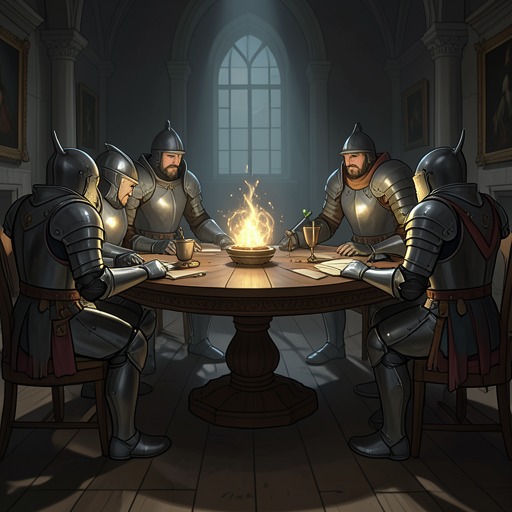
At one of its defining appearances, the Grail enters Arthur’s hall covered with white samite. Neither the knights nor the account can identify its bearer; its passage is followed by food and drink suited to each knight’s desire, and then the vessel suddenly disappears. The episode makes the Grail’s presence both generous and inaccessible: it provides a feast, but does not become an object the company can possess or inspect at will.
A later vision makes that wonder more explicit. At King Pelles’s court, a white dove carries a small golden censer into the hall, and a young woman bears a golden vessel. Pelles kneels in prayer, as do the others present, while Launcelot asks what the sight means. The king identifies the vessel as the most precious thing any living person possesses and names it the Holy Grail. He adds that when it goes about, the Round Table will be broken. The vision thus joins devotional revelation to political foreshadowing: the Grail’s appearance is a grace, but it also signals the approaching fracture of the fellowship.
The revelation at Pelles’s court is bound to the future of Galahad. Pelles knows that Launcelot will have a child by his daughter Elaine, and that the child will be named Galahad and will achieve the Grail. Because Launcelot loves Queen Guenever, Pelles’s plan depends on Dame Brisen’s enchantment: she proposes to make Launcelot see Elaine as though she were the queen. The prophecy gives the vessel a place in the lineage and future of the knights, while the means by which that future is arranged complicate the contrast between sacred destiny and human conduct.
Signs, Access, and the Beginning of the Quest
At Camelot on Whitsunday, the knights find new gold lettering in the Round Table’s seats, including an inscription marking when the Siege Perilous may be occupied. Launcelot refuses to claim a sword intended for another knight, despite Arthur’s confidence in his excellence. He also warns that a knight who attempts and fails to draw it will be wounded. Launcelot understands the signs as heralding the beginning that very day of the adventures of the holy vessel. The moment sets the quest within a system of signs and restricted access: neither the Grail nor the objects associated with its coming are available simply by claiming the highest reputation.
The Grail’s arrival in the hall confirms the transition. Thunder shakes the place; a sunbeam, described as seven times brighter than ordinary daylight, enters, and the knights are illuminated by the grace of the Holy Ghost. After a long silence, the Grail passes through the hall under white samite, seen by no one in its bearing. The knights receive food and drink according to their desires, but the vessel then vanishes. The event gives the whole company a shared encounter while leaving the object beyond their grasp, turning collective wonder into the impetus for a quest.
The quest’s episodes make the Grail’s power concrete. During an appearance at a silver table, a sick knight rises, approaches the vessel on his hands and knees, touches and kisses it, and is healed. The recovery presents the Grail not merely as a sign of spiritual authority but as the instrument of a bodily cure within the story. Elsewhere, Galahad and his companions are fed by the Grail, including during their imprisonment, and Galahad is made king. Provision and authority thus come through the same sacred presence, even in circumstances where the knights lack ordinary freedom.
Prophecy, Healing, and Narrative Significance
The Grail’s history also reaches back to the wound that follows Balin’s blow to King Pellam. Merlin explains that Pellam remains wounded for years and will not recover until Galahad heals him during the quest. The place contains part of the blood of Jesus brought to Britain by Joseph of Arimathea, and the spear involved is identified with the spear that wounded Jesus. The account makes Pellam’s eventual cure part of the same religious history that defines the Grail: Joseph’s relics and Christ’s blood connect the earlier disaster to the later healing promised through Galahad.
This connection gives the Grail quest a reparative shape. A violent act has consequences extending beyond the immediate combat; the land and its rulers remain marked by damage until the destined knight arrives. Galahad’s healing of Pellam therefore fulfills more than a personal prophecy. It answers an injury associated with the sacred history of the relic and draws the earlier tale of Balin into the larger spiritual design of the quest.
The episodes place the Grail in deliberate contrast with the ordinary measures of knightly achievement. Launcelot is esteemed as the finest knight, but he knows that the prophesied sword is not his; Galahad, not Launcelot, is identified as the child who will occupy the Siege Perilous and achieve the vessel. The distinction does not erase Launcelot’s importance: his son’s destiny is announced through the Grail, and Launcelot himself witnesses its manifestations. It does, however, separate worldly prowess from the role the story assigns to the quest’s chosen achiever.
Taken together, the Grail’s appearances move the romance from marvel to summons, from summons to trial, and from trial toward healing. The vessel nourishes the knights without remaining in their possession, reveals a future that precedes their understanding, and links Britain's Christian past to the fellowship’s coming division. Its presence is therefore both a promise of grace and a measure of the distance between witnessing holiness and being able to attain it.